Saturday, May 9, 2015

Return to Fox Creek School

It is early spring 2015 and three years since my last visit to the one room schoolhouse on Lower Fox Creek in Chase County.

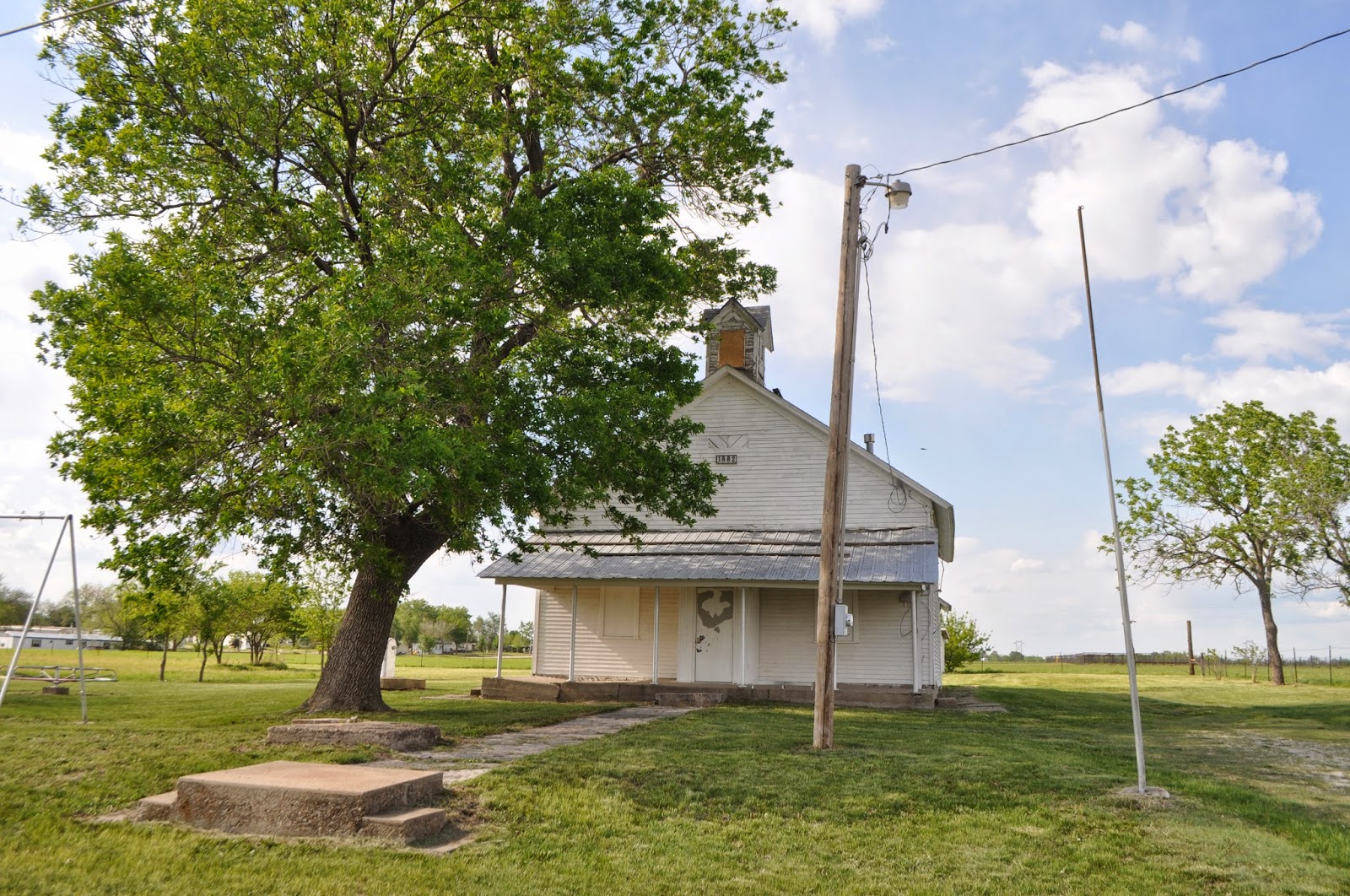
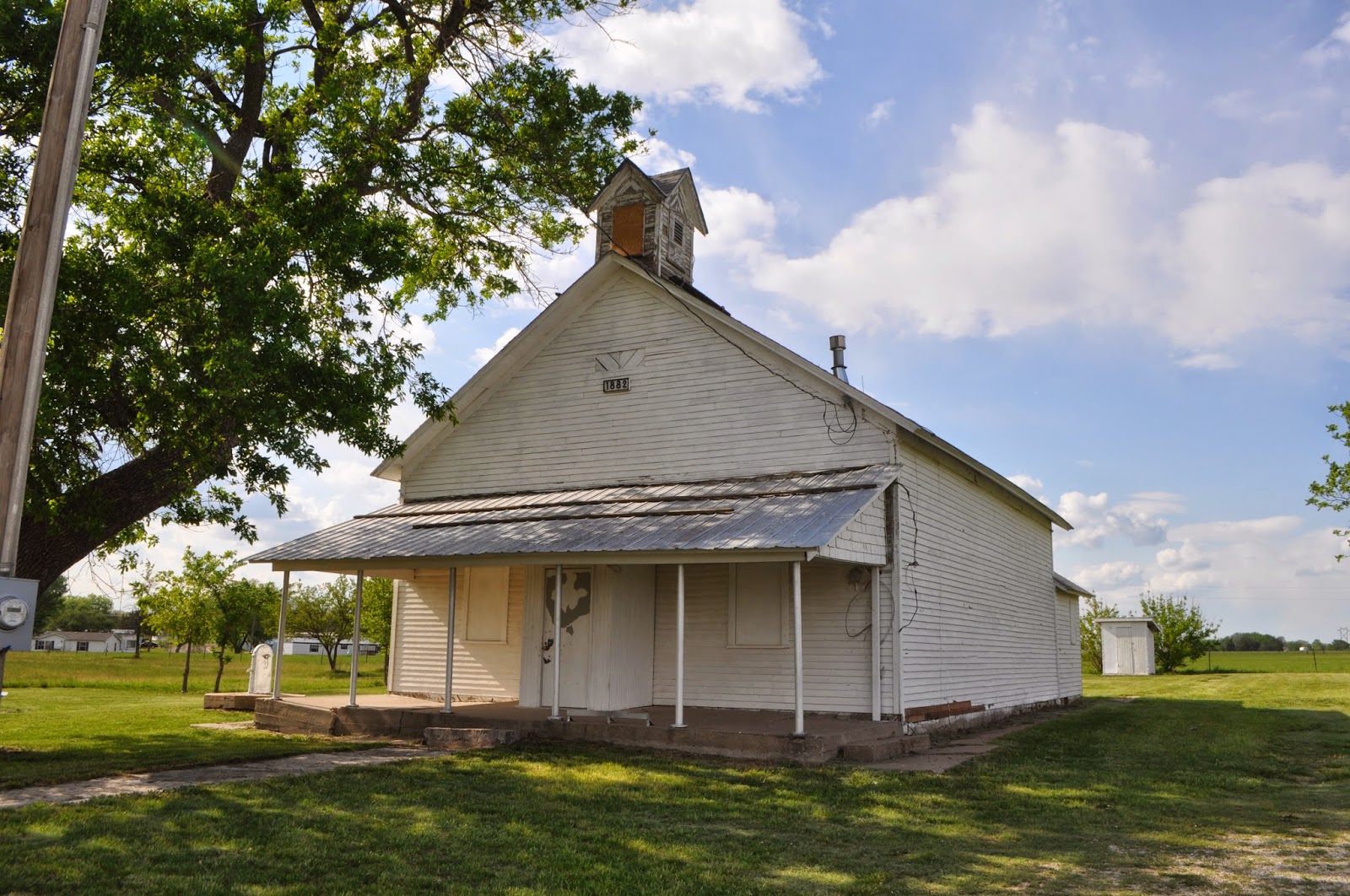
Lower Fox Creek School, north view

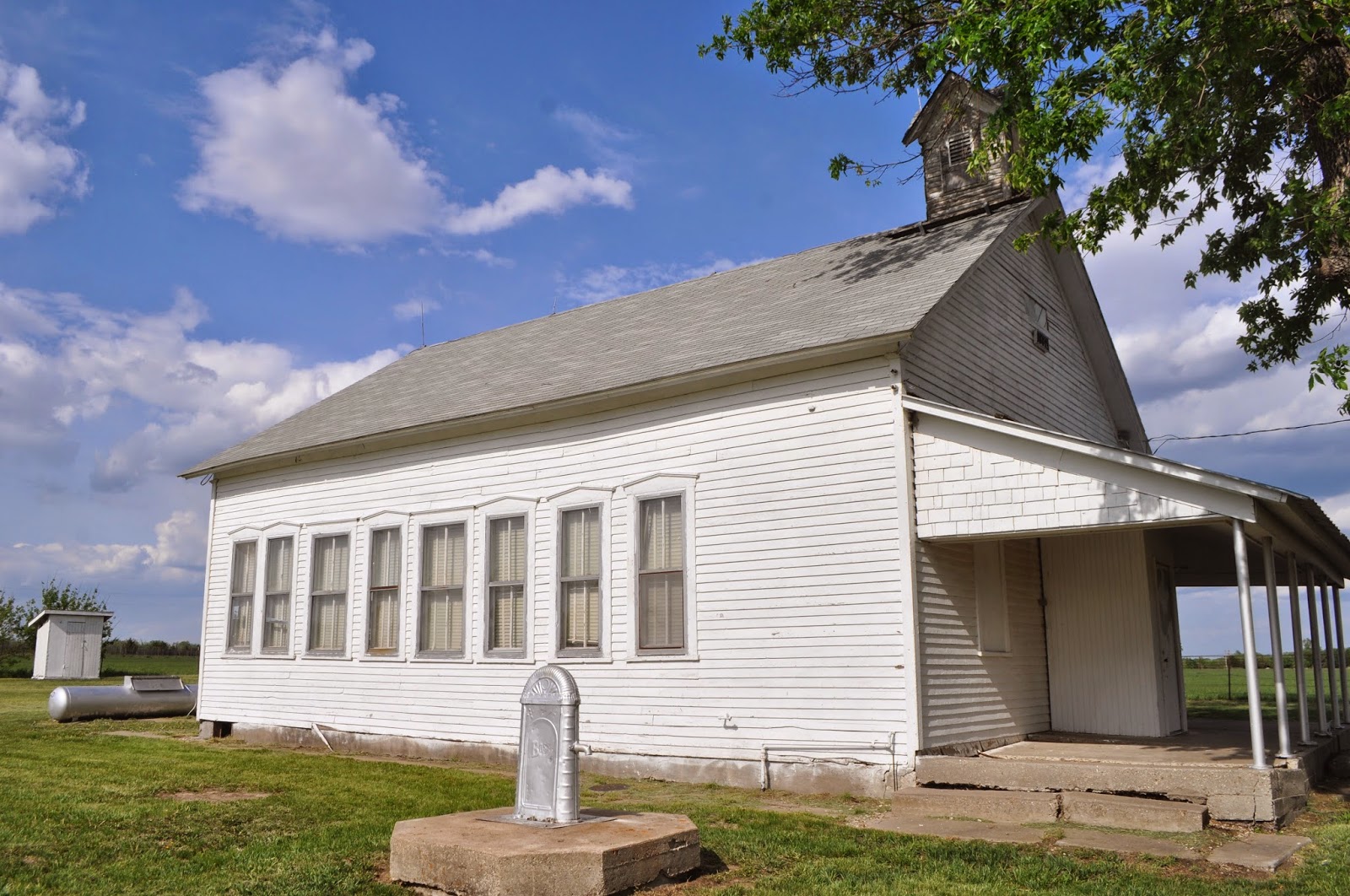
The limestone school built in 1884 now sits within the Tallgrass Prairie, National Preserve in Kansas, just two miles north of Strong City on Highway 177.

Lower Fox Creek Schoolhouse, south view
The first school term began on September 1, 1884, with Dora Peer as the teacher. She earned $35 a month. A new teacher taught for the following five school years, their names: Roy Hackett, Mrs. Gus Walsh, Minnie Ford, Ada Baker, and Maude Johnston. 

Learn more by visiting the National Park Service site.

Friday, May 16, 2014

Cottonwood School 26

Take Highway 50 west of Emporia for five miles. There just off the highway to the north is a simple wood framed building with white siding and small steeple. The front door faces south to the highway. There is a single entrance and windows on the west side. This is Cottonwood School Number 26.

The tracks of the Atchinson, Topeka and Santa Fe Railroad parallel Highway 50 a mile to the south.The Cottonwood River meanders alongside the railroad tracks.

This is farm land and was so in 1878 when the school was fairly new. Below is an image of a farm from Americus, Kansas taken from the Lyon County Atlas of 1878 and found in Kansas Memories.

Residence of J.W. Loy near Americus, Kansas


If you have gone to the town of Plymouth, Kansas, then you have gone five miles too far.

The Walter M. Anderson Collection of photographs of schools in the and around Emporia contain two older photographs of the school, numbers 13 and 14. The school (Number 26) first appears in print in the Atlas of Lyon County, Township 19, in the Lyons County Atlas of 1878.


Lyons County, Kansas 1878

The school is well taken care of.


Kansas One Room Schoolhouse Lyons County, 1882


Sunday, November 17, 2013

Back to Silkville

Over the years I have made many trips to Silkville, Kansas. Silkville was the dream of Frenchman Ernest Valeton de Boissière, who arrived from his native Bordeaux in 1869. He purchased 3,500 acres of land in southwest Franklin County. It is located about two miles south of Williamsburg, southwest of Ottawa on Old Highway 50. His dream was an utopian community sustained by the making of silk.

Silkville one room school


De Boissière planted mulberry trees, imported silkworms, built a 60-room building to house the original 40 French immigrants and then some. He a established a winery, purchased cattle, made butter, and built an ice house, so that his community could be totally self-sufficient. He even built a one-room school house for the children of the community. At the time, Silkville’s library was the largest library in Kansas. Boissiere's little community won various awards for its silk, including prizes at the Philadelphia Exposition in 1876 and the Paris Exposition in 1886.

By 1892, the dream was over. Silk was produced more cheaply elsewhere, and the members of the community found greater opportunities on their own. The property was donated to the Odd Fellows and then later sold when the fraternal organization could not afford the upkeep. In 1916, a fire destroyed the three story house.

Today, all that remains is the one room school house that stands silently with its back to Old Highway 50.

It is November 2013. The school has stood for more than one hundred years, but it is beginning to show its age.

Sunday, May 12, 2013

Greenwood County, Kansas

The population of Greenwood County in 1878 was 7,648. Greenwood County is just east of Butler County on Highway 400. The county seat and most populous city is Eureka, settled in 1857.

Map of Greenwood County, Kansas 1878
Map of Greewnwood County, Kansas from Skyways.com. Schoolhouses are marked on the map.


Kansas State Board of Agriculture. First Biennial Report of 1878, Greenwood County.
First school houses: Eureka. township, on what is now the town site of Eureka, in 1857, by M. L. Ashmore, L. Prather, David Tucker and Edwin Tucker; Salt Springs township, 1871, district No. 45; Salem township, 1868, district No. 10; Pleasant Grove township, 1861, by an unorganized district school, taught by A. P. Loveland; Twin Groves township, 1873, district No. 41; Janesville township, 1857, William Sterling and others; there are five organized school districts in the township, each having a school building; Fall River township, by district No. 25, no date.
 I want to find the Otter Creek schoolhouse, found on flicker and panoramio. Go east on Highway 400 to Agard Rd..

Monday, December 31, 2012

The Children's Blizzard of 1888

The idea for this story came from an article in the Wichita Eagle, published today, December 31, 2012.

The Children's Blizzard of 1888.

On January 12, 1888, a blizzard struck the northern Great Plains hitting Kansas, Nebraska, Minnesota, and Iowa, as well as the Dakota Territory. The storm came to be known as the Schoolhouse, the School children's, or simply the Children's Blizzard, for among the estimated 500 who perished in the storm, 213 were children, many stranded in the storm after venturing home from their one-room schoolhouses.

The weather was freakish. Warm weather preceded the storm and as a result, children walked to school without hats, gloves, or coats. As an example, one weather station on January 12 reported the temperature at 2:00 p.m. at a balmy 44°F. Seven hours later (9 p.m.), it would plummet  to −11°F. Then at it lowest, the temperature fell to −42°F. The cold was accompanied by whipping winds of 45 miles an hour, heavy snow, and drifts of 15 feet.

Crawford County Iowa account, written by Myra Hamann.

One of the better accounts of the blizzard in Nebraska is written by Jolene McHugh in the Omaha Viewfinder, recounting teacher Mary Kieffe’s story, as told by Dorothy Creigh in “Adams County: The Story.” 
“That day was mild and the pupils and I were playing “fox and geese’ at the noon intermission, there being a little snow. At about 12:45 it began to rain and drove us indoors. It soon changed to snow and by 3 o’clock we had to abandon study, it became so dark. The larger boys formed a chain reaching to the coal shed and passed in at least a half ton of coal. We had a fine time the fore part of the night. We “spelled down,’ sang, organized a debate and recited everything from ‘Mary Has a Little Lamb’ to ‘Spartacus to the Gladiators of Rome.’ From midnight the hours dragged slowly though, as we dared not go to sleep it was so cold. … I got roundly scored by some pious mamas whose youngsters I cared for, for having played a game of cards during the night with some of the pupils, and one of the district dads wanted to deduct one day’s wages because I didn’t keep school the next day nor make it up.”
The stories were not all happy. One teacher in Winner, South Dakota released his 12 students. They were found the next day frozen to death.

Minnie Freeman, the Fearless One

Minnie Freeman and students from the song

One fearless teacher, Minnie Freeman of Mira Valley, Nebraska led her students, tied together by rope, from the school to her boarding house. Lyon & Healy, a Chicago music publisher, released a song about her deeds: "Song of the Great Blizzard 1888, Thirteen Were Saved or Nebraska's Fearless Maid."

See Islandnet.com

Read With a Bang Not a Whimper, pages 23 on, for more stories.

Thursday, December 27, 2012

Clay Center

Clay Center, District 41, Butler County

Kansas State Board of Agriculture, First Biennial Report of Butler County, 1878, notes that Union Township, as the area was then known, had school districts Nos. 41 and 42 as early as 1874.


Don't be confused.

A larger, more prosperous city called Clay Center is in Clay County, Kansas. This Clay Center is in Butler County, an intersection at southeast 210th and Cole Creek. To get there one can drive west from Latham, south from Leon, east from Douglass, or north from Atlanta.


The Schoolhouse

The Kansas One Room School House Project by Kansas Heritage includes the school in its 1944-45 list of Butler County schools. A second list, Heritage Project includes the school.

Clay Center, District 41, Butler County, Kansas


Did you ever hear the saying, "A dollar a day"?

From Skyways we learn about the number of schools and teacher pay in Butler County schools in 1878.

Schools. - Number or organized districts, 125; school population, 5,043; average salary of teachers, per month, male, $31.80, female, $26.65.

The term a "dollar a day" started with cowhands who were paid a dollar a day and food for their work. Teachers could rightly complain about pay back then for they were paid similar wages.

Before you get up on your high horse about the discrepancy in male and female pay consider this -  male teachers often supported a family. Usually, female teachers taught for a year or two and married. Not always, mind you, but that was the way it was. Hey, don't get mad at the messenger (me), take it up with grandpa. Also, female teachers lived at home or with a student's family.

Again, from Skyways (id.):

School houses built during 1878, frame, 9. Total number of school houses, 123; log, 1; frame, 103; stone, 19. Value of all school property, $74,473. No report on shade trees.

In 1878, with a total of 123 schools for just over 5,000 students, the average school contained 40 children, but remember this list includes city schools such as those in El Dorado and Andover.

School attendance varied over the years. These small schools often had from ten to twenty children ranging in all ages. This can be seen from the few tattered old photos of schools and there students. Also, keep in mind there were no yellow school buses.  Children walked to school, a few rode horses, so schools were as common as a QuikTrip and located every two to three miles in the more populated areas.. In school, the older children would help the younger ones.The teacher had her desk at the front of the class and would give personal instruction.


Clay Center, Butler County
The school sits on the southwest corner of the intersection where Clay Center is located. Google Maps gives a birds-eye view. The north branch of Rock Creek passes just to the north of the school. I have not discovered any information to date on this Clay Center. My visit to Clay Center takes place the day after Christmas on a cold but sunny day. As the wind is not blowing it is a good day for a walk with the dogs Tobie and Sammy, one a mixture of Terrier, Shephard, and Coon, the other a German Shepherd.

South View
The school is typical of many one room schools with a foyer to shield the classroom from the biting winter cold. A central chimney spout can be seen, so the furnace was in the middle of the school room. One unusual feature is that there are no windows on the north side. In fact, the only windows on the school are on the south and east sides.

View from the west.
As with many schools, the land was typically donated by a farmer and the school often sits next to a field. District 41 school is shielded by several Oak and Ash that border Rock Creek. The creek is now dry with only a pool of water here and there.

Outhouse
Every school had its outhouse or two behind the school and District 41 is no exception. The door and the platform are long gone but the sturdy native limestone that make up the walls still stand.

Stone Fence along the road to Latham
The countryside is rolling pasture, good for hay, corn and cattle. Along the way to Latham one passes what must be the longest stone fence in all Kansas.

Ancient Bridge
If you take the time to look around, you'll discover a bit of Old Kansas. I don't like to give out the location of every site, so I will just say that it is near Latham. For the real stone bridge fans, visit Tour Butler County, which lists the still standing stone bridges in Butler County. I guess this one is #11.

Tour Butler County pdf

Saturday, August 13, 2011

Butler County First Schools

The following information on Butler County was taken from the Kansas State Board of Agriculture First Biennial Report of 1878. This report and others are online thanks to Skyways and the Genweb Project. The map of Butler County indicating schools and other county maps are similarly available at the same site.
[Butler County] First school houses:

Augusta, 1869, district No. 13;
Bloomington township, 1872, district No. 5;
Bruno township, by district No. 72, date not given;
Chelsea township, 1860, by district No. 10 - first school taught by Miss Satchel;
Clifford township, 1871, by district No. 21 - first school taught by S. L. Roberds, afterwards county superintendent;
El Dorado township, first school house built by subscription of settlers, afterwards purchased by district No. 2;
Fairmount township, 1872, by district No. 70;
Little Walnut township, 1872, by district No. 59;
Plum Grove township, 1872, by district No. 53; Prospect township, by district No. 79;
Rock Creek township, 1870, by subscription of settlers in district No. 30;
Rosalia township 1872, by district No. 35 - there are four school houses in this district;
Spring township, August, 1872, by district No. 45;
Towanda township, 1863, built of logs, by settlers;
Union township, 1874, by districts Nos. 41 and 42;
Walnut township, by district No. 64.